First72Hours — Post-Adoption Success
A branching scenario that changes the character of a return — not just the number.

Don't take my word for it. Read a real first-night moment, make a decision, and see what happens.
 Jordan — your rescue mentor
A live, AI-assisted practice scenario
Try it by text, or switch to voice. Loads only when you start — nothing autoplays.
No two attempts feel identical — the scenario responds to what you actually say.
The first fourteen days get misread — and the dog goes back.
Most returns don't happen because someone stopped caring. They happen in the first two weeks, when a frightened dog hides, won't eat, flinches at a raised hand, or has an accident on the rug — and the new adopter reads all of it as this isn't working.
It is working. That's decompression — normal, expected, temporary. But nobody told the adopter what week one actually looks like, so a good match gets undone by a misread. The rescue absorbs the return, the dog absorbs the churn, and the next adopter inherits a dog who's now been surrendered twice.
I designed for the decision, not the dog.
A checklist of dog-care facts wouldn't move the number. The failure point isn't knowledge — it's the moment an adopter interprets a hard night and decides what it means. So I built a branching scenario that drops the learner into those exact moments and asks them to choose.
Every wrong answer is a kind one. Nothing punishes the learner for choosing what a caring person would plausibly choose — the scenario just plays the choice forward, honestly, so they feel the cost of the misread instead of being scolded for it. Then it lets them try again.
Practice the judgment call in a place where getting it wrong is free.
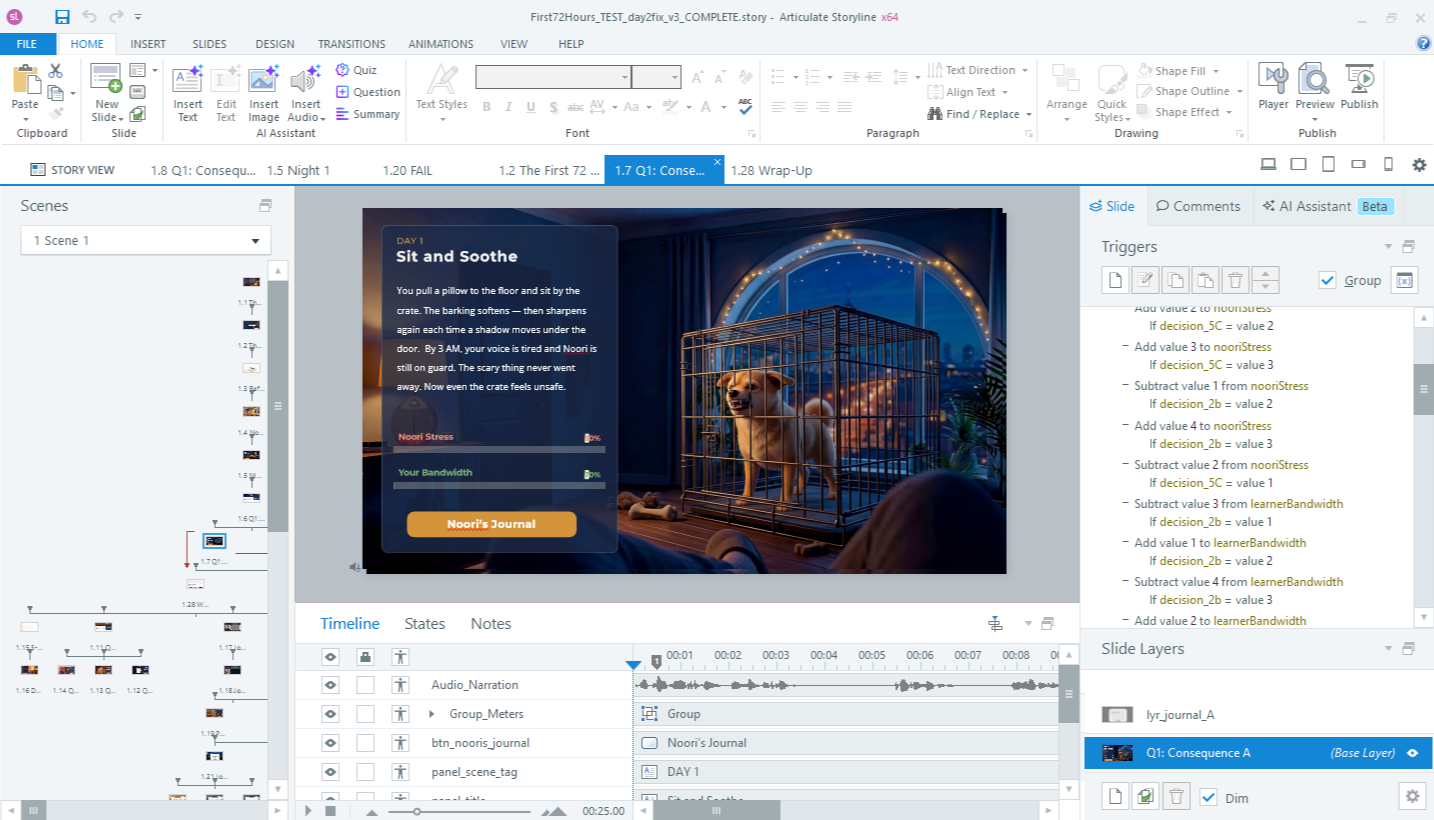
The program remembers. Behind the Day 1 "Sit and Soothe" scene, a stack of triggers adds and subtracts nooriStress and learnerBandwidth with every decision — the same state the on-screen meters and Noori's Journal read back to the learner later.
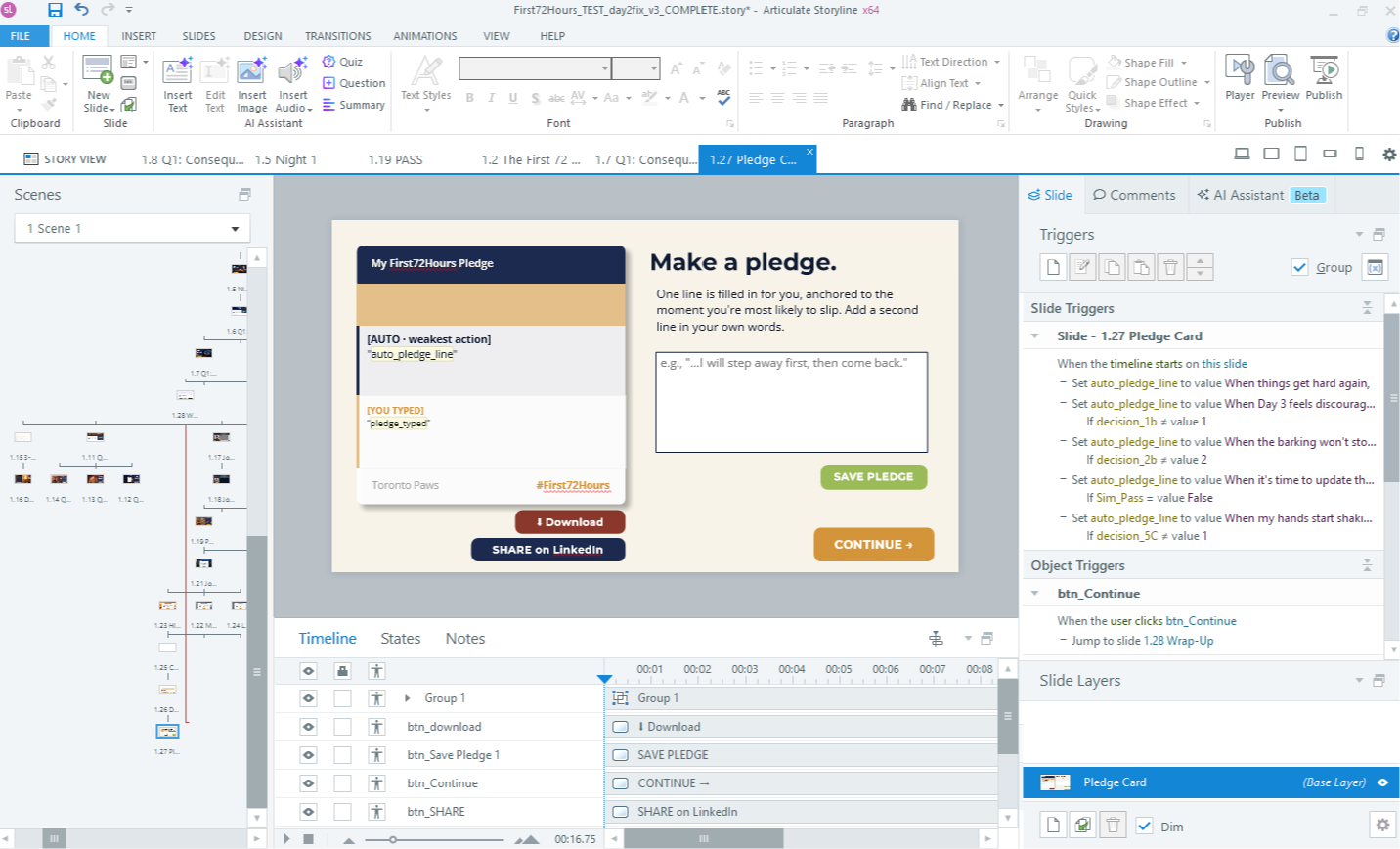
A pledge in their own words. The pledge card pre-fills one line chosen by triggers from the learner's own weakest decision — When the barking won't stop, When Day 3 feels discouraging — then asks them to add a second line in their own words. Save, download, or share it: the commitment is designed to leave the screen with them.
The research doesn't say pre-adoption training lowers returns. I'm not going to pretend it does.
The largest controlled study of pre-adoption education found no statistically significant difference in return rates between adopters who received the intervention and those who didn't. That's the honest baseline I built on top of — not around.
So the goal isn't to shrink the return rate — the evidence won't support that promise. The goal is expectation calibration: sending adopters into week one already knowing what decompression looks like, so a hard night reads as expected rather than as failure.
And when a return does happen, the aim is to change its character — from a panicked, day-three surrender to an informed, unhurried decision made after the dog was given a real chance. Same outcome on paper, a completely different outcome for the dog.
Six decisions that make the scenario feel like a consequence, not a quiz.
The program remembers
An adaptive state model tracks what the learner chose earlier and carries it forward. The dog that got space on night one behaves differently on night three than the dog that got crowded — the scenario is answering your history, not replaying a script.
A scored phone call, not a quiz
The assessment is a simulated call with a rescue mentor. The learner talks through what's happening and gets scored on judgment in context — reading the situation and responding — instead of picking the right letter from four options.
A pledge in their own words
Near the end the learner writes a commitment in free text — not a checkbox. Putting the promise in the learner's own language turns a completion into an intention, and the scenario reflects it back to them before they leave.
Redo only what you missed
Remediation is targeted. Instead of restarting the module, the learner is routed back through exactly the beat they misread — the variables know which one — so a second pass reinforces the gap without punishing the parts they already had.
Every wrong answer is a kind one
No option is a trap or a joke. Each choice is one a caring adopter might actually make, and the feedback plays the consequence forward with empathy instead of a red X. The learner feels the misread rather than being marked for it.
Captioned, narrated, self-paced
Every scene is captioned and narrated, and nothing advances until the learner does. Accessibility isn't a bolt-on pass at the end — it's built into how each of the 45 captions was written and timed alongside the scene it belongs to.
What it proves, and what I'd carry forward.
- — Scenario beats content. Putting the learner inside the judgment call — not in front of a fact sheet — is what makes week-one behavior feel rehearsable.
- — Honesty is a design constraint, not a caveat. Naming what the research does and doesn't support kept the whole build pointed at expectation calibration instead of an inflated promise.
- — State makes empathy possible. The 84 variables aren't complexity for its own sake — they're what lets the scenario respond to the specific learner in front of it and keep every wrong turn a kind one.
- — A better return is still a result. Changing the character of a return — informed, unhurried, after a real chance — is a humane outcome even when the headline number holds.
First72Hours grew out of real animal-welfare work — shared in working meetings with animal welfare NGO teams at the 2026 AVA Summit.